Ozémé Carrière and the Men of Bois Mallet
In May 1865, more than a month after General Robert E. Lee surrendered the Army of Northern Virginia at Appomattox Court House, Confederate cavalrymen were still riding into the woods west of Opelousas to hunt down St. Landry Parish families. When Lieutenant Colonel Louis Amédée Bringier and troopers of Colonel Louis Bush's 4th Louisiana Cavalry cornered Ozémé Carrière and his chief lieutenant, Martin Guillory, in the timber of Bois Mallet near present-day Eunice, they were not chasing stray bandits. They were trying to break a tightly bound Creole and Indigenous prairie kinship network that had defied Confederate rule for more than two years.
For over a century, old county histories and pro-Confederate memoirs painted Ozémé Carrière and the men of Bois Mallet as lawless outlaws. Yet when you set those nineteenth-century accounts aside and read the primary federal records side by side—the 1860 U.S. Federal Census, the wartime dispatches in the Official Records of the Union and Confederate Armies, and the postwar testimonies preserved before Congress—a completely different picture emerges.
Before a single shot was fired on the prairie, the bond holding Bois Mallet together was blood and household kinship. On the 1860 U.S. Federal Census for St. Landry Parish, twenty-nine-year-old Ozémé Carrière—born in the parish in 1831—was recorded living on a small farm in the household of two free women of color, Marianne (Mary) Guillory and her younger relative. Marianne's brother, Martin Guillory, stood beside Carrière not merely as a wartime lieutenant, but as family. Together, the Carrière and Guillory households sat at the center of an older network of free people of color, small-holding Acadian farmers, and families of Atakapa-Ishak descent stretching across Bois Mallet, Prairie Plaisance, and Bayou Plaquemine Brûlée.
When the Confederate Congress enacted conscription in 1862 and Union forces swept through the Bayou Teche corridor in the spring of 1863, the Confederate government demanded that small farmers and free men of color surrender their labor, livestock, and lives for a government built to preserve plantation slavery. Across western St. Landry and Calcasieu parishes, men refused. By the summer of 1863, hundreds of draft resisters, free people of color, enslaved men seeking freedom, and disillusioned conscripts gathered in the woods and coulees of Bois Mallet under the leadership of Ozémé Carrière and Martin Guillory.
Confederate officers in Opelousas and Niblett's Bluff called them "Jayhawkers," borrowing a partisan label from the Kansas border wars to strip their resistance of political legitimacy. Yet the Confederates' own internal dispatches preserved in the Official Records admit how deeply rooted the movement actually was. By February 1864, Confederate reports estimated that Carrière commanded roughly a thousand men across the southwestern prairies, intercepting Confederate supply trains, raiding conscription camps, and rendering Confederate authority unenforceable outside the main towns. Confederate Captain H. C. Morell of Opelousas warned his superiors in alarm that Carrière was growing "daily more and more popular with the masses," explaining that ordinary families viewed Carrière and his men as their champions working to bring the war to an end.
That grassroots support from surrounding homesteads is what kept the prairie bands alive—and it is what brought down the full weight of Confederate retaliation. In the spring of 1864, Confederate Major General Richard Taylor ordered the 4th Louisiana Cavalry under Colonel Louis Bush and Lieutenant Colonel Louis Amédée Bringier into St. Landry Parish with explicit instructions to shoot resisters on sight and pacify the prairies. Over the next twelve months, Bringier's cavalry waged a relentless campaign across Bois Mallet and the Mermentau and Calcasieu watersheds, executing dozens of suspected resisters and targeting the households that sheltered them.
By May 1865, with the Confederacy collapsing and the threat of the draft over, most of the men who had taken to the woods had already returned to their farms, leaving Carrière and Martin Guillory with a small remnant of roughly fifty men in the Mallet woods. Bringier's cavalry struck their camp that month. Ozémé Carrière, thirty-four years old, was killed in the firefight, and Martin Guillory was severely wounded. Guillory survived his wounds long enough to organize the remaining prairie men into a Union-aligned unit known as the Mallet Free Scouts, only to be gunned down near his home by local vigilantes in July 1865 at the age of twenty-five.
What the county histories left out—and what the federal archives preserved—is that killing the leaders did not erase the families. In the 1870s, when Congress established the Southern Claims Commission and the 1877 House Select Committee on the Use of the Army in Certain Southern States took sworn testimony on Reconstruction violence in St. Landry Parish, the surviving Guillory, Carrière, and neighboring Creole households stepped forward on the official record. Their sworn statements, alongside the 1860 census schedules and St. Landry Parish courthouse successions, confirm that the people of Bois Mallet were never rootless outlaws. They were landed, interconnected Southwest Louisiana families defending their households, their freedom, and their ground through the darkest years of the nineteenth century.
The Document
Documented Sources and Primary Repositories
Eighth Census of the United States (1860): St. Landry Parish, Louisiana, Population Schedule (Opelousas Post Office), household enumeration of Ozémé Carrière, Marianne (Mary) Guillory, and adjoining Guillory households, National Archives and Records Administration (NARA) Microfilm Publication M653.
U.S. War Department: The War of the Rebellion: A Compilation of the Official Records of the Union and Confederate Armies, Series I, Volumes 26, 34, and 48 (Washington, D.C.: Government Printing Office, 1880–1901) — dispatches of Major General Richard Taylor, Colonel Louis Bush, Lieutenant Colonel Louis Amédée Bringier, and Captain H. C. Morell regarding conscription resistance in St. Landry and Calcasieu parishes.
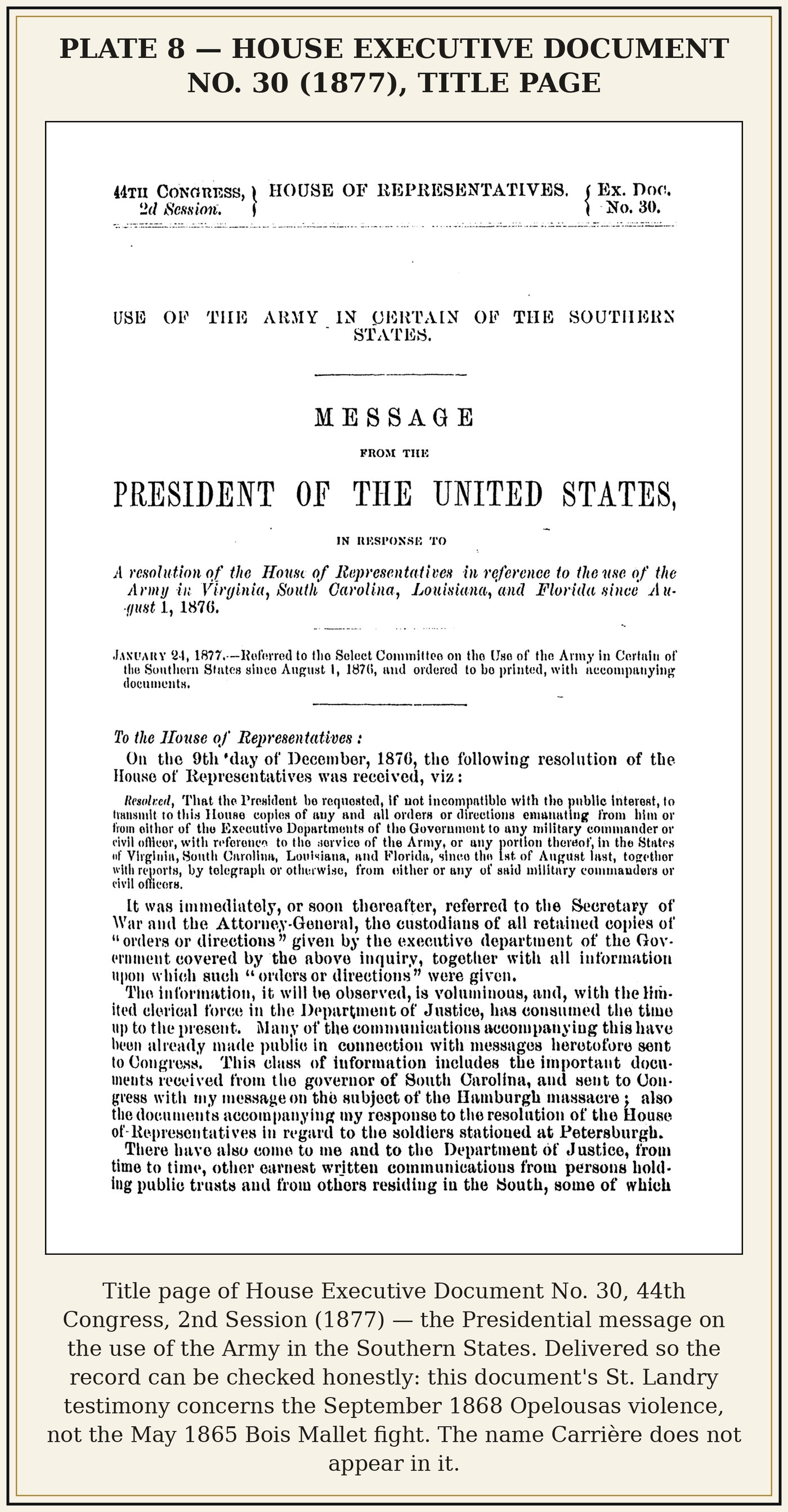
U.S. House of Representatives (44th Congress, 2nd Session): Report of the House Select Committee on the Use of the Army in Certain Southern States (1877) — sworn testimony concerning the May 1865 Bois Mallet engagement, the Mallet Free Scouts, and the July 1865 killing of Martin Guillory.
Records of the Southern Claims Commission (1871–1880): Allowed and Disallowed Case Files for St. Landry Parish, Louisiana, Record Groups 217 and 233, National Archives and Records Administration (NARA), Washington, D.C.
St. Landry Parish Clerk of Court: Probate and Succession Dockets (1865–1870), Opelousas, Louisiana.
The documented work is shared as it surfaces on Facebook.
© 2026 Clayton Antwan Williams. All rights reserved.