Giants on the Prairie
Let’s talk about it.
If you look at the standard history books covering 19th-century Louisiana, they usually give you a long list of Anglo plantation barons and white French aristocrats. But there is a massive chapter of our history that standard pages leave completely out—the story of a brilliant, multi-racial Creole network that built a real estate and investment empire so vast it completely dominated the southwestern prairies. The Donato Colony in St. Landry Parish stands as plain proof of what happens when our ancestors locked arms, mastered the legal system, and secured thousands of acres of land.
The physical anchor of this legacy was the Martin Donato House, built right around 1825 along the old prairie road just north of Opelousas. It wasn't just a home. Built as a classic single-story Creole cottage with heavy timber posts and raised piers, this building served as the nerve center for an absolute agricultural powerhouse. The family accumulated nearly 8,000 acres of prime land stretching straight across the country between Opelousas, Washington, and Port Barre. They operated their own cotton gins, managed thousands of head of cattle, and ran a highly sophisticated private lending and financing operation that the entire region depended on.
This empire didn't form in a vacuum. It thrived because of the tight, deliberate choices our prairie ancestors made to protect their assets from outside speculators. The foundation traces back to Donato Bello, an Italian mixed-Creole lineage that established a massive physical footprint on the land. His son, patriarch Martin Donato Bello, laid the groundwork by ensuring the family’s holdings remained unified. The community locked down its leverage through deep family intersections:
The Donato and Meuillion Alliance: Martin’s son, Francois Auguste Donato, married Marie Denise Meuillion, weaving the Guillory and Papillion branches tightly into the family network. They raised a massive family that aggressively protected their acreage right through the Civil War and the decades that followed.
The Lemelle and LeDay Networks: Through continuous intermarriage and strategic land transfers, these families kept the prairie settlements whole, blocking outside speculation from breaking up their territory.
A Strategy for Survival: Even while operating within the harsh realities of the antebellum economy, the patriarchs systematically used their wealth to pull their people out of the system. In his 1847 will, Martin Donato used the courts to legally emancipate multiple individuals, securing them immediate cash and dedicated educational funds so they could stand on their own feet as free citizens.
When the Civil War tore through the state, Union officers actually occupied the Donato homestead, using its solid construction as a strategic military headquarters. While the incoming American system did everything it could to break and bankrupt families of color through the fractures of Reconstruction and Jim Crow, the Donato dynasty forced the system to respect their name. The bloodline remained continuous, the geography stayed unbroken, and the estate survived. The
Donato Colony stands as a powerful, document-verified testament to the brilliant architects, real estate investors, and absolute power brokers who stood as giants on the prairie and left a continuous legacy right here on the soil.
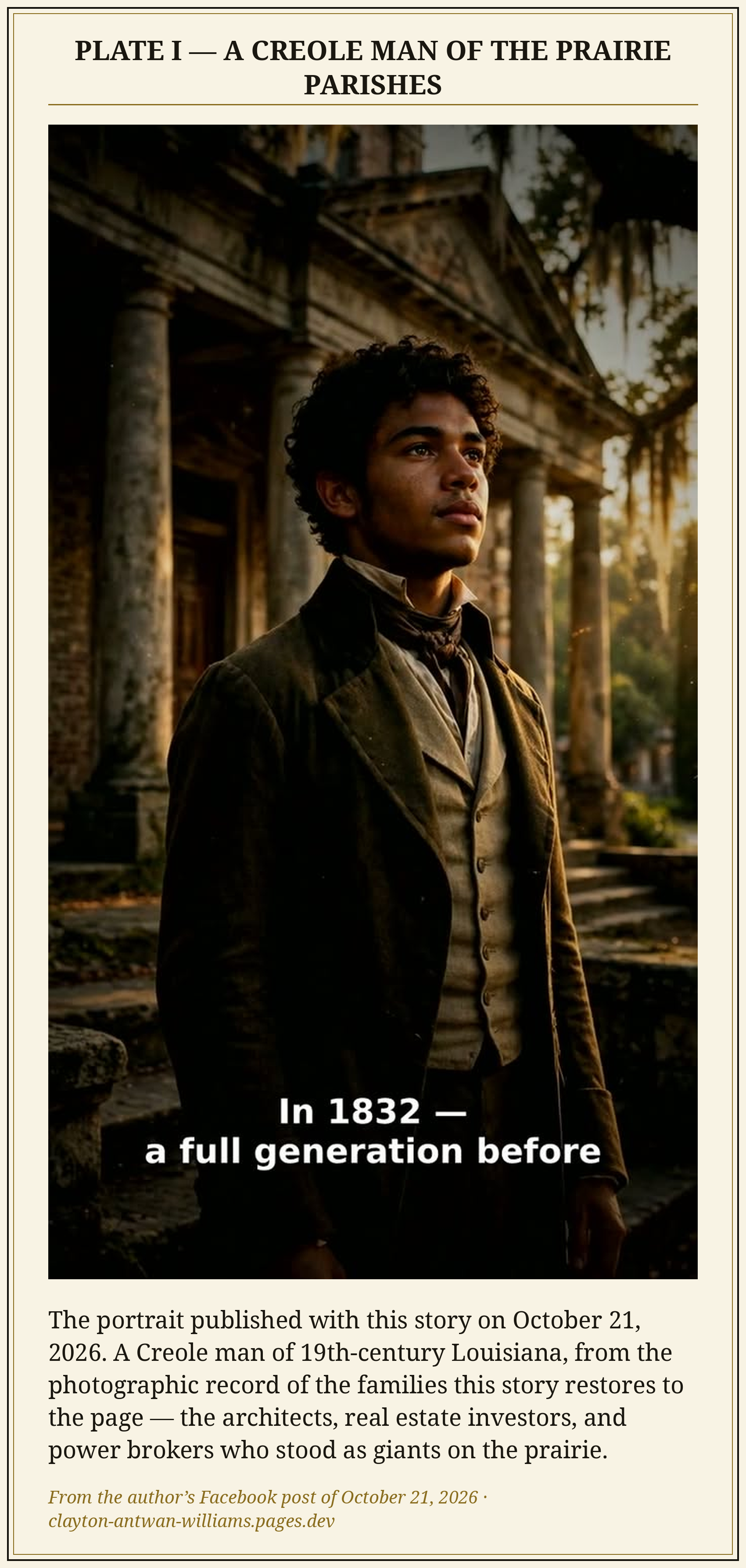
The Picture
Publication
First published on the author’s Facebook page, October 21, 2026. The text stands as written.
Clayton Antwan Williams is a family historian, independent archival researcher, and citizen of the Atakapa-Ishak Nation specializing in primary-source documentation of Southwest Louisiana Creole and Indigenous family lineages.
The documented work is shared as it surfaces on Facebook.
© 2026 Clayton Antwan Williams. All rights reserved.