Henriette
The 1835 civil trial that declared Henriette’s mother, Marie-Josèphe Díaz, legally incompetent provides a rare, stark look into the fracturing of their family and the breakdown of the plaçage system under pressure. In the court transcripts and medical assessments filed in New Orleans, the arguments focused heavily on her mother’s complete inability to manage her real estate assets and her increasing emotional instability, which local physicians attributed to a mix of financial panic and severe family stress.
Witnesses described a woman who had spent her entire life carefully curating a specific social status for her daughters, only to watch Henriette deliberately walk away from it. The legal team representing Henriette argued that without immediate judicial intervention, the family's properties would be entirely lost to mismanagement. By winning this case and being named her mother's legal curator, Henriette gained direct control over the family's wealth, giving her the exact financial independence she needed to fund her early, illegal ministries.
When the Civil War arrived in 1861, it completely upended the fragile social structure the Sisters of the Holy Family had learned to navigate. New Orleans fell to Union forces relatively early in the war, in May 1862, which brought an entirely new set of complications for the order just months before Henriette’s death. The city was placed under strict military occupation by Union General
Benjamin Butler, creating severe food shortages, medical supply scarcity, and widespread economic collapse. The Sisters had to adapt their shelter and nursing efforts instantly, pivoting from quietly evading local slave catchers to surviving a militarized city. They kept their home for the elderly running by pleading for rations from the
Union army, relying on their reputation for neutrality and their history of nursing yellow fever victims to secure basic provisions from the occupying forces.
The transition from a slave-holding society to a war zone forced the order into a much more public role than they had ever taken before. Facing a massive influx of newly emancipated people who entered New Orleans with absolutely nothing, the small community of women expanded their secret classrooms into open, rapidly growing schools.
Henriette did not live to see the end of the war, dying in late 1862, but the survival strategies she built allowed the Sisters to navigate the chaos of
Reconstruction. Freed from the restrictive antebellum Black Codes and the threat of the city watch, the order finally secured the legal right to incorporate under their own names, purchase property openly, and eventually adopt the full religious habits that had been denied to them for decades.
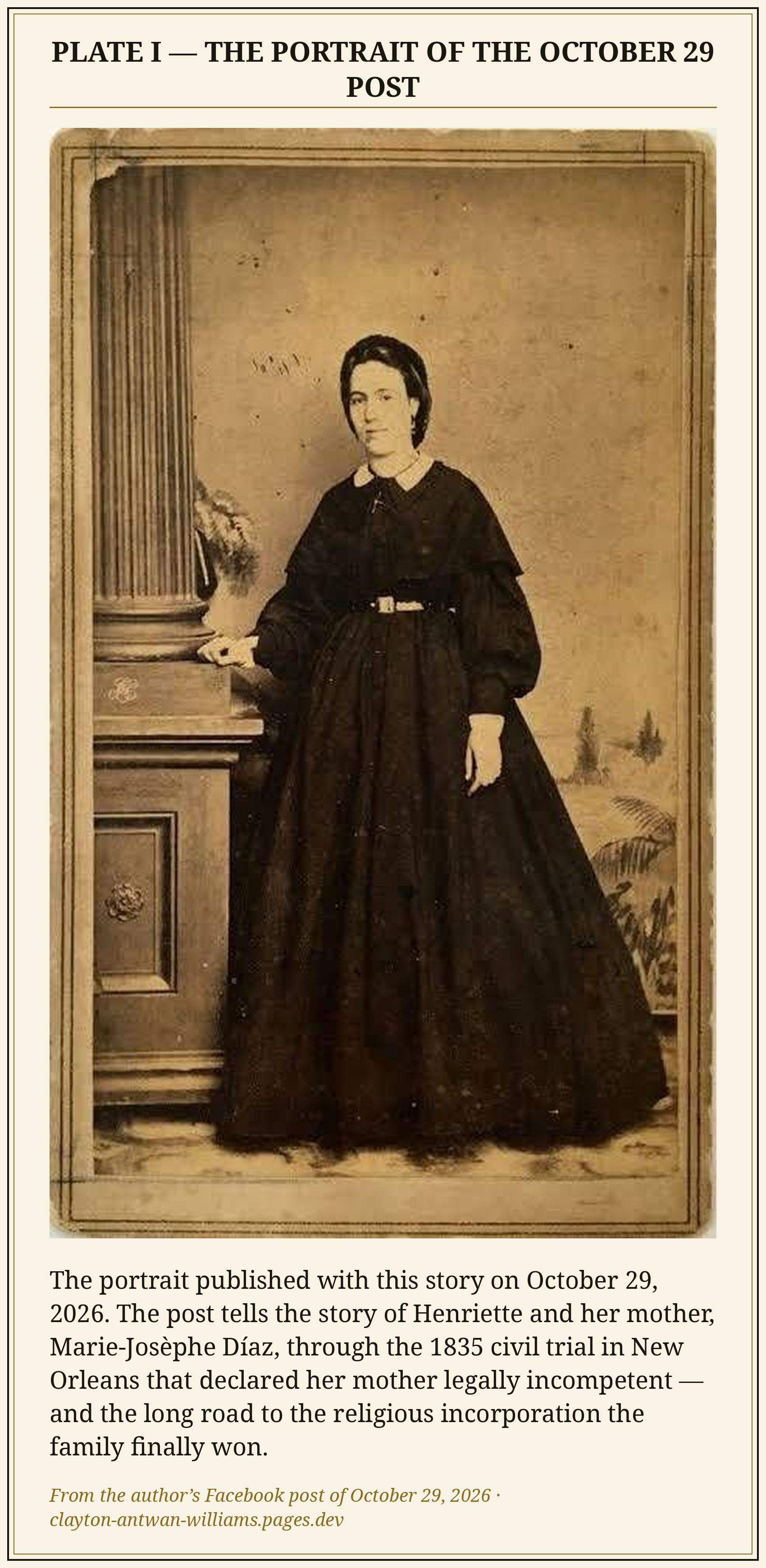
The Picture
Publication
First published on the author’s Facebook page, October 29, 2026, where it reached more than 2,300 readers. The text stands as written.
Clayton Antwan Williams is a family historian, independent archival researcher, and citizen of the Atakapa-Ishak Nation specializing in primary-source documentation of Southwest Louisiana Creole and Indigenous family lineages.
The documented work is shared as it surfaces on Facebook.
© 2026 Clayton Antwan Williams. All rights reserved.