Jois
let's talk about it
The modern, simplified narratives often paint a flat, powerless picture of the antebellum South, conditioning people to believe that every person of color was stripped of agency and hiding in the shadows. But if you blow the dust off the original Spanish and French civil records, a completely different universe appears—one where free Creole women of color operated as high-powered property magnates, brilliant legal strategists, and absolute anchors of economic wealth.
To understand the sheer scale of what these matriarchs pulled off, you have to look directly at the massive clash between two completely different legal systems: the incoming Anglo-American common law and the deep-rooted Latin civil law of the Louisiana Territory. Under the English common law that governed the American colonies, a married woman was completely crushed by the doctrine of coverture. The moment she married, her legal identity was erased. She could not own land in her own name, sign a contract, or control a single dollar independent of her husband. But Louisiana was built on an entirely different legal bedrock—the French and Spanish civil codes, including Las Siete Partidas and the Code Noir. Under this Latin civil framework, free women of color possessed distinct, formidable legal rights. They could enter into binding contracts, acquire vast real estate portfolios, and sue white citizens in open court—and win.
When the United States took control of the territory after the Louisiana Purchase, the incoming Anglo rulers were absolutely terrified of the fluid, three-tiered society they encountered. They found free people of color who were highly educated, exceptionally wealthy, and legally protected. The archival record even documents frantic requests made to the last French governor to hastily alter the laws right before the transfer because the incoming Americans feared the level of independence already established on Louisiana soil. The draconian racial restrictions that intensified in the late antebellum era were not the original baseline of Louisiana history; they were an aggressive, reactionary Anglo attempt to dismantle a system of wealth and autonomy that Creole families had spent generations building.
Because traditional marriage to white partners was barred under the changing codes, free Creole women masterfully turned the legal system into a weapon for family survival. By remaining legally unmarried, a free woman of color maintained the powerful status of femme sole—an independent legal entity. When land was purchased in New Orleans neighborhoods like the Faubourg Marigny and Tremé, or across the vast rural prairies of Southwest Louisiana, the titles were registered exclusively in the woman’s name. This meant the property belonged entirely to her separate estate, making it completely untouchable by the man's creditors or his white common-law heirs.
Furthermore, because the changing laws placed strict limits on how much wealth a white man could leave to his mixed-race children in a will, couples engineered highly sophisticated "simulated sales." While the partner was still alive, land, livestock, and cash were legally transferred to the woman through standard, notarized business acts of sale. When white relatives aggressively filed lawsuits after a partner's death to strip these families of their inheritances, these resilient matriarchs didn't back down. They hired sharp lawyers, marched into the parish courthouses, produced their notarized deeds, and successfully argued that their wealth was the direct result of their own independent labor, business smarts, and shared capital investments.
This ironclad legal strategy created a formidable class of independent landowners, merchants, and investors who held serious economic leverage long before the Civil War. They pooled their resources through tightly woven kinship networks, using their independent financial standing to build self-sustaining communities, purchase the freedom of enslaved relatives, and ensure their ancestral bloodlines stayed firmly rooted in the soil they owned.
The true history of these resilient matriarchs is not a mystery found in a hidden diary, and it cannot be represented by generic, theatrical imagery. Their legacy is written permanently into the dirt they owned, the court victories they secured, and the authentic signatures they left in the public notarial archives to ensure their families survived.
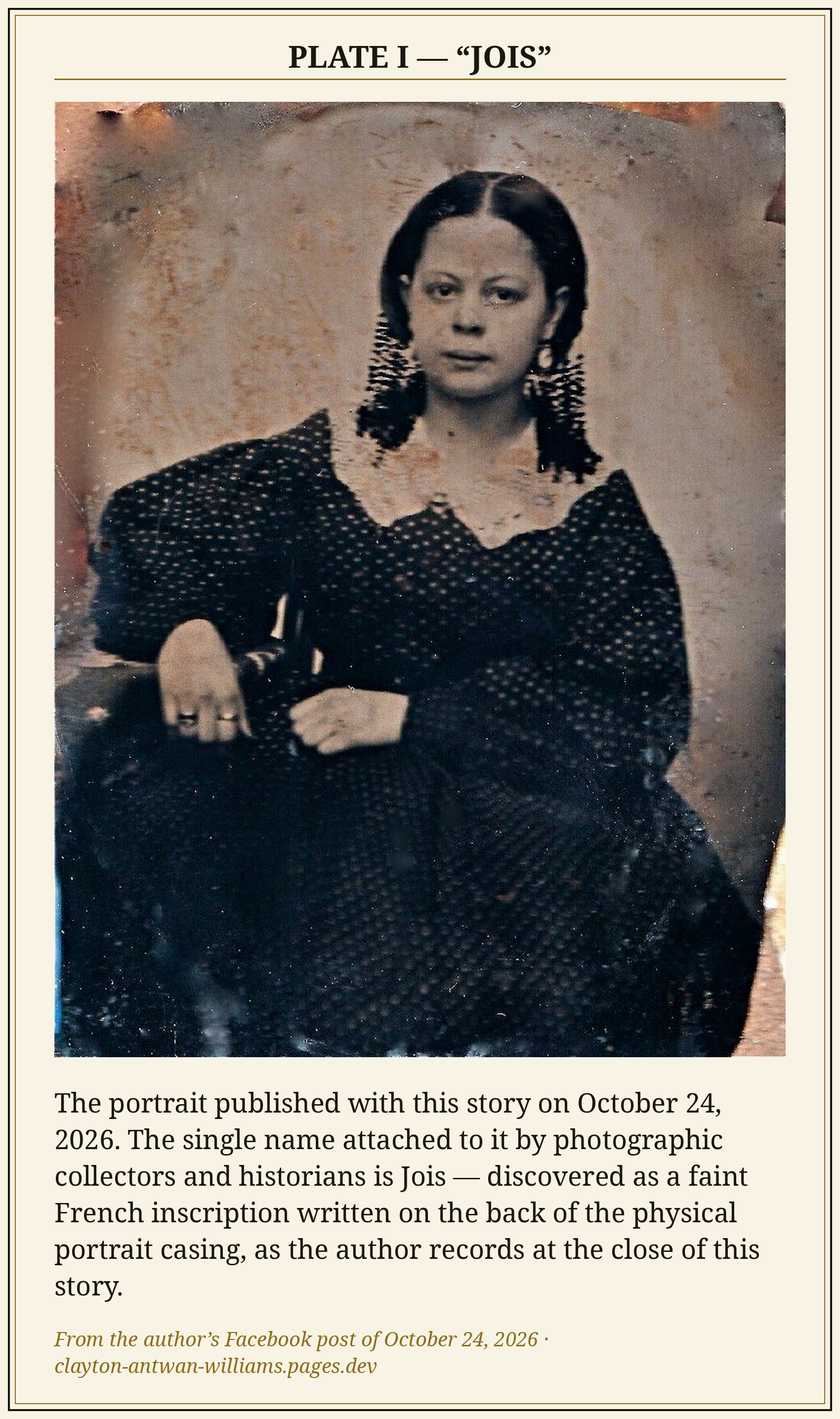
Look closely at the face in the 1855 ambrotype accompanying this post. Discovered in New Orleans with a faint French inscription on the back that simply reads "Jois," her true legal identity and full family name have been completely obscured by time. Yet, her expensive mid-19th-century attire, her elaborately styled hair, and her absolute poise tell an undeniable story of wealth, stature, and independence. She is the visual embodiment of a generation of brilliant Creole legal strategists who looked a hostile system dead in the eye and rewrote the rules to protect their legacy.
Now, there were people trying to claim that the last picture I used was of a girl who was not from Louisiana, but she absolutely was, just like this woman is. Even when we do not know their specific individual names or the exact intimate details of their daily struggles, we know for a fact that they come from that exact same period and that very same culture. The very fact that these women were captured in a photograph during the mid-1800s means they carried a highly unique, prominent history about them. Photography was an elite luxury back then. We use these portraits in our stories because the names of many of these women were left out of the history books, simply because their individual identities were not considered important to the people who were capturing the images at the time. But their presence is undeniable.
When the public archives clearly prove that free Creole women masterfully weaponized Latin civil law to defeat white litigants, secure property empires, and establish independent autonomy, why does mainstream history continue to hide their brilliance behind a narrative of absolute powerlessness? Who do you think this woman was, and what family line do you think she anchored? Are we ready to confront the truth of our ancestors' economic warfare, or will we let traditional history books keep them in the shadows? Drop your thoughts below.
This 1/9th plate ambrotype dates back to circa 1855 and originated in New Orleans, Louisiana. The single name attached to it by photographic collectors and historians is Jois, which was discovered as a faint French inscription written on the back of the physical portrait casing.
The Picture
Publication
First published on the author’s Facebook page, October 24, 2026, where it reached more than 3,900 readers. The text stands as written.
Clayton Antwan Williams is a family historian, independent archival researcher, and citizen of the Atakapa-Ishak Nation specializing in primary-source documentation of Southwest Louisiana Creole and Indigenous family lineages.
The documented work is shared as it surfaces on Facebook.
© 2026 Clayton Antwan Williams. All rights reserved.